

Creating forms and surveys isn’t just about asking questions and collecting answers. It’s about asking the right questions — and giving users the right way to answer them. The format matters as much as the question itself. A dropdown, a star rating, and an open text field each give you a different kind of insight.
In 2026, this is easier than ever. AI can help you write sharper questions, analyse open-ended answers in seconds, and even adjust follow-up questions based on what a user just said. It turns a static form into something closer to a real conversation.
The goal stays the same as always: ask less, learn more, and make every question count.
How Many Questions Should You Ask?
The right number of questions largely depends on the type of form you’re creating. For example, a SaaS company running an NPS survey should keep it to a single number rating on a 0–10 scale. There’s no need to overload it with extra fields — in fact, the shorter the survey, the more people actually finish it. A focused, one-question NPS will almost always get a better response rate than a long form that asks for everything at once.
The rule of thumb: ask only what you genuinely intend to act on. Every extra question is one more reason for someone to drop off before they hit submit.
Collect What Matters
For some surveys — education surveys being a perfect example — the details you collect before the real questions matter just as much as the questions themselves. Before you get to the core of the survey, you should first capture some basic information about the student: their name, grade or year, course, and perhaps the institution or batch they belong to. These details may feel like a formality, but they’re what give the actual answers their meaning.
Think about it: if a student rates a course poorly or praises a particular teacher, that feedback is far more useful when you know who it’s coming from and what context they’re in. A complaint about course difficulty means something very different from a first-year student than from a final-year one. Without these details, you’re left with answers floating in a vacuum — opinions you can’t segment, compare, or act on with any confidence.
So always lead with the essentials. Capture who the student is first, then move into the questions that matter. That way, every response you collect is something you can actually trace, group, and turn into a meaningful decision. Just keep these detail fields quick — ask for enough to give context, but not so much that people give up before reaching the real questions.
Make the Answer Type Easy
Finally, make answering effortless. The easier it is for someone to respond, the more likely they are to finish — and the more honest their answers will be. Match the answer type to the question: use dropdowns or multiple choice when you want clean, comparable data, star or number ratings for quick satisfaction checks, and open text only when you genuinely want the customer’s own words. Avoid making people type when a tap would do. Every bit of friction you remove is another completed response you get back.
When to Use What Answer Type
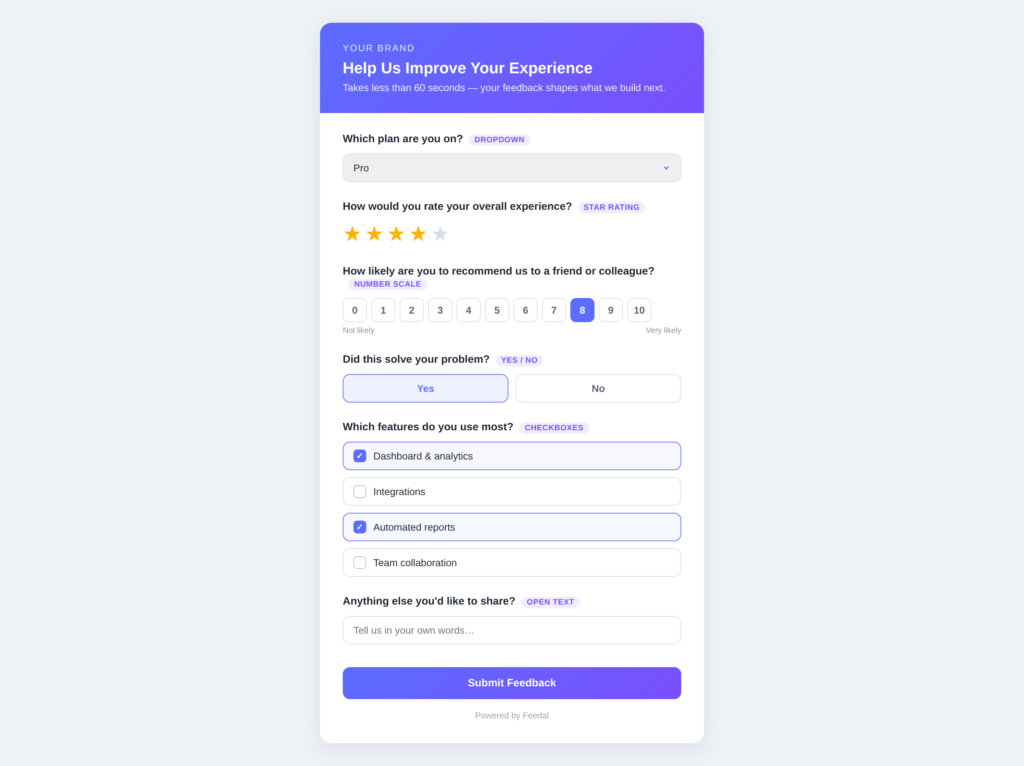
Here’s a simple guide to choosing the right format for each question:
- Dropdown / Multiple choice — Use when answers fall into clear, fixed options and you want clean, comparable data. Best for questions like “Which plan are you on?” or “How did you hear about us?”
- Star rating — Use for quick, friendly satisfaction checks. Ideal for rating a product, a support interaction, or an overall experience where a 1–5 feel is intuitive.
- Number scale (0–10) — Use for measurable, benchmarked scores like NPS, where you need precision and want to track the figure over time.
- Yes / No (or toggle) — Use for simple, binary questions that keep things fast. Great for “Did this solve your problem?” or “Would you recommend us?”
- Open text — Use only when you genuinely want the customer’s own words and deeper context. Powerful for insight, but use sparingly, since typing takes effort and lowers completion rates.
- Checkboxes (select multiple) — Use when more than one answer can apply, like “Which features do you use?” Lets users pick everything relevant without forcing a single choice.
Here’s an example form:
Conclusion
In a marketing landscape obsessed with visibility, it’s easy to forget that being seen is only half the battle. The brands that pull ahead are the ones that actually listen — and survey marketing remains one of the most efficient, genuine ways to do exactly that. It’s one of the oldest tools in marketing, and in 2026, with AI helping you ask sharper questions and make sense of answers in seconds, it’s also one of the smartest.
The principles are simple. Ask the right questions of the right people. Keep your forms short and easy to answer. Collect just enough context to make every response meaningful. And once the feedback comes in, act on it — protect what’s working and fix what isn’t before a frustrated customer quietly walks away.
Whether you’re a startup talking to your first hundred customers or a large brand processing thousands of responses, the goal is the same: turn what your customers tell you into your next move. So don’t just market at people — ask, listen, and let their answers guide you.
Ready to start? Create your first form with Feedal — it’s free — and begin turning customer feedback into real growth today.
Frequently Asked Questions
What is survey marketing?
Survey marketing is the practice of using forms and surveys to gather direct feedback from customers about your products, services, or brand. It helps businesses understand customer needs, measure satisfaction, and generate genuine leads by listening to what their audience actually wants.
Is survey marketing still effective in 2026?
Yes. While it’s one of the oldest marketing methods, it remains highly effective — and AI has made it even stronger. Modern tools can now help write better questions, analyse open-ended responses instantly, and adapt surveys based on user answers, making feedback faster and more insightful than ever.
How many questions should a survey have?
It depends on the type of survey, but shorter is almost always better. The fewer questions you ask, the more people complete the survey. A focused survey — like a single-question NPS — usually gets a far higher response rate than a long one. The rule of thumb: only ask what you genuinely intend to act on.
What’s the difference between a star rating and an NPS score?
A star rating (usually 1–5) is best for quick, friendly satisfaction checks, like rating a product or support experience. NPS uses a 0–10 number scale to measure how likely someone is to recommend you, and it’s designed to be benchmarked and tracked over time.
How do I analyse the feedback I collect?
It depends on your scale. Smaller businesses with fewer customers can review responses one by one and even reach out personally. Larger brands with thousands of responses can feed the data into AI tools — like Claude, GPT, or Feedal’s built-in AI — to instantly surface sentiment, behaviour, and trends.
What’s the best tool to create surveys?
There are many options, but Feedal lets you build branded forms one question at a time, share them via email, direct link, QR code, or an embedded website script, and analyse responses with built-in AI. Your first form is free, making it an easy place to start.