
There’s a moment every marketer, product manager, or researcher dreads: you’ve spent hours crafting the perfect survey, launched it to your audience, and the results come back — flat, shallow, and nearly useless. Low completion rates. Vague answers. No real insight.
I’ve been there more times than I care to admit. And for years, I accepted it as the cost of doing business. Then AI-powered form builders entered the picture, and I genuinely haven’t looked back.
The Old Way Was Broken (We Just Didn’t Know It)
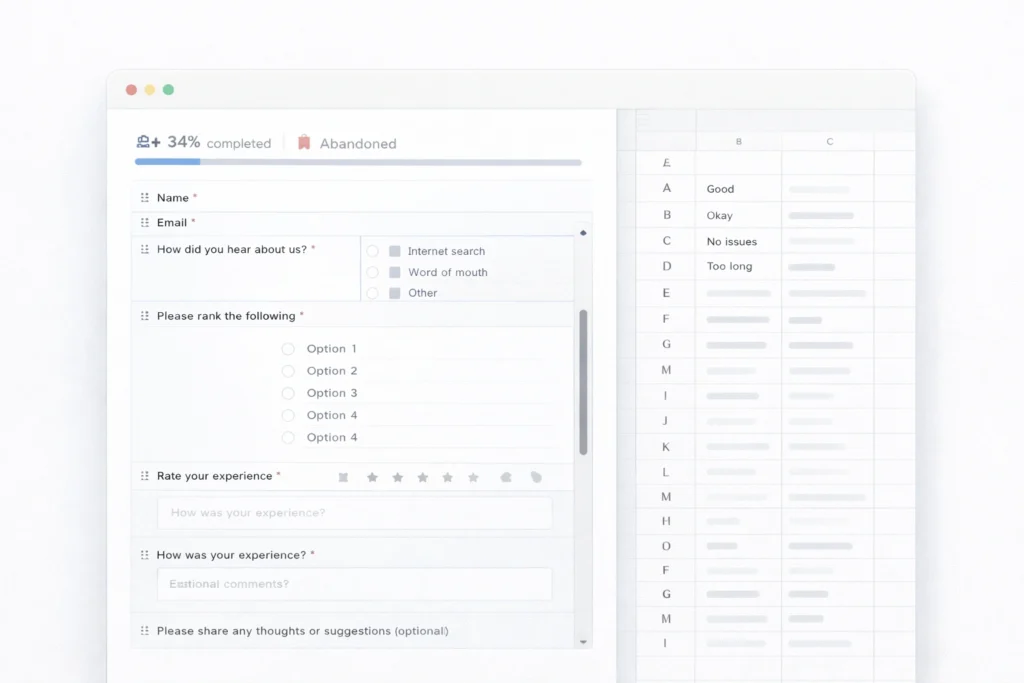
Traditional survey and form tools handed you a blank canvas and a set of drag-and-drop fields. The intelligence — if you could call it that — was entirely on you. You had to know which questions to ask, how to sequence them, what response types to use, and how to avoid leading your respondents toward biased answers.
Most people, understandably, got this wrong. Either their surveys were too long and got abandoned halfway through, or they were too vague to generate actionable analytics. The feedback they collected ended up in a spreadsheet that no one revisited after the first week.
The problem was never the data. It was the form itself.
What an AI Form Builder Actually Does Differently
An AI form builder doesn’t just give you a prettier template; instead, it fundamentally rethinks how you create, deliver, and analyze a survey.
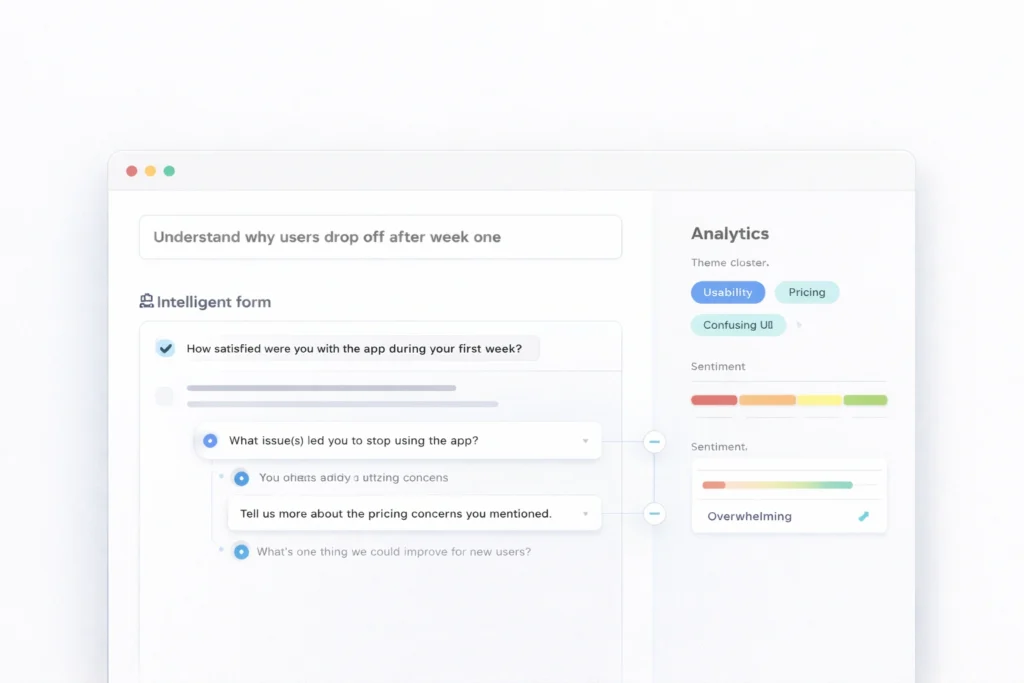
So what does that look like in practice? First, you describe what you’re trying to learn — for example, “I want to understand why users are dropping off after their first week of using my app.” Then, within seconds, the AI generates an intelligent, structured survey. Rather than producing a generic list of questions, it builds a contextually aware, logically sequenced set of prompts tailored specifically to your goal.
Along the way, the AI accounts for question fatigue, response bias, and the natural flow of conversation. Based on your objective, it chooses between open-ended questions and multiple-choice formats to gather the right kind of feedback. Moreover, it suggests smart branching logic. For instance, if someone says they stopped using the app because of pricing, the next question digs deeper into that reason instead of shifting to something irrelevant.
On its own, that’s a game-changer. However, it’s only the beginning.
Smarter Surveys Mean Better Feedback
While testing AI-driven form tools, I noticed a sharp rise in feedback quality. This didn’t happen only because I improved the questions — though that helped. More importantly, far more people actually finished the surveys.
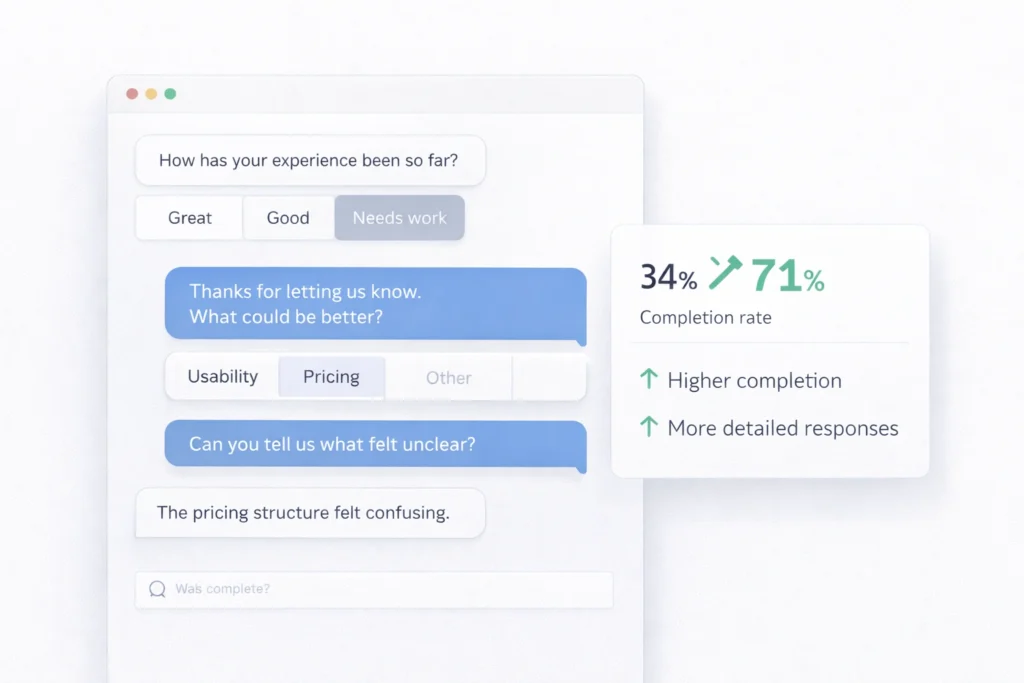
Shorter, smarter surveys feel more like conversations. As a result, completion rates go up. When people feel heard instead of questioned, they give clearer and more honest answers. The feedback no longer feels like a checkbox task. Instead, it becomes a real dialogue.
To test this, I worked with a SaaS client. We replaced a 22-question onboarding survey with a 7-question AI-generated version. As a result, completion rates jumped from 34% to 71%. In addition, the written feedback became more detailed and more useful. This wasn’t random. It showed a clear shift in how feedback can drive better business decisions.
Analytics That Actually Tell You Something
Collecting feedback is only half the job. The other half — and the part most teams get wrong — is making sense of it.
Traditional tools give you bar charts and pie charts. They look good in slides. However, they rarely help you make real decisions. You still have to read through hundreds of open-ended responses to spot patterns. That takes hours. Worse, it often adds human bias.
AI-powered analytics change that. Instead of forcing you to scan every response, modern AI tools review them at scale. They group similar themes, track shifts in sentiment, and highlight insights you might miss. As a result, you don’t read 400 separate responses. Instead, you read a clear summary of what those 400 people actually meant.
This is where the real ROI appears. For example, knowing that 62% of churned users said your product felt “too complicated” is helpful. However, spotting that the word “overwhelming” spiked right after your last product update is far more powerful. Because of that insight, you can trace the issue to a specific change. And that’s what leads to smarter product decisions.
Real-World Use Cases Worth Exploring
Customer Feedback Loops: Instead of sending quarterly surveys and hoping for replies, teams can use AI form builders to send short surveys at the right moments. For example, they can trigger one after a support call, after a user tries a feature for the first time, or right after a purchase. As a result, teams collect feedback while the experience is still fresh. Because of this, the insights feel more relevant and far more useful.
Employee Engagement: In the same way, HR teams can use AI-driven surveys to gather more honest input. When a survey feels like a real conversation rather than a corporate form, employees open up. In addition, anonymous and adaptive formats reduce fear. As a result, people respond with greater clarity and candor.
Market Research: AI form builders help researchers move faster. In the past, teams spent weeks designing surveys, collecting data, and reviewing results. Now, however, they can move from question to insight in just a few days. As a result, teams make decisions sooner. More importantly, they stay closer to what customers actually think.
Product Development: Feedback on a new feature only works if users understand what they are reviewing. Otherwise, the input becomes vague or misleading. To solve this, AI-generated surveys guide users step by step. For example, they break complex features into simple parts and ask focused questions. In addition, they reduce bias by keeping the flow clear and logical. Because of this, product teams gather sharper insights and improve features with more confidence.
What to Look for in an AI Form Builder
Not all AI form builders are the same. After testing several, I’ve learned what really matters.
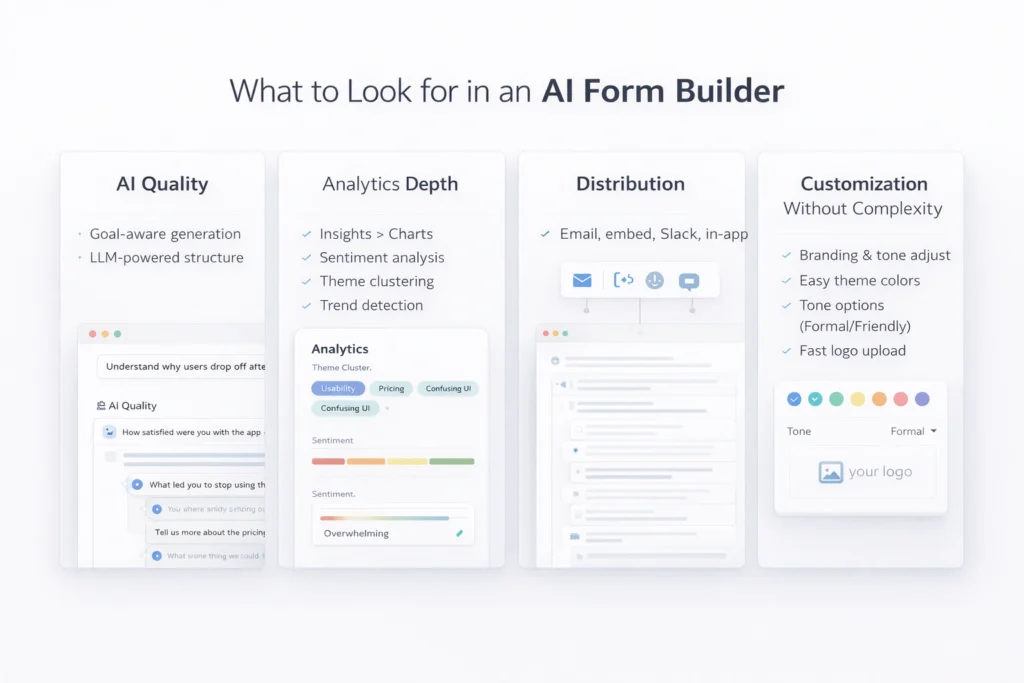
First, the quality of the AI is critical. Some tools use “AI” as a buzzword and offer slightly better templates. However, others rely on strong language models that truly understand your goals. As a result, they generate surveys that match your intent. The difference in quality is clear.
Next, analytics depth matters more than analytics breadth. You don’t need 40 charts. Instead, you need the right insights presented clearly. For example, strong tools highlight sentiment, group similar themes, and spot trends in open-text answers. That’s what actually helps you decide what to do next.
Ease of distribution is also important. Yet many teams overlook it. After all, even the best survey is useless if no one sees it. That’s why the top tools connect directly with platforms your audience already uses — such as email, web embeds, and messaging apps. As a result, the survey feels natural, not intrusive.
Finally, look for customization without added complexity. You should be able to adjust branding, tone, and AI-generated questions with ease. At the same time, you shouldn’t need a developer or spend hours learning a new system. The best tools keep things powerful — but simple.
Why Feedal Is Worth Your Attention
If you’re actively shopping for an AI form and feedback tool, Feedal.io is one worth putting on your evaluation list.
What stood out to me was how cleanly it integrates the survey creation, feedback collection, and analytics experience into a single, coherent workflow. You’re not toggling between three different dashboards or exporting CSV files to run your own analysis. The AI assists at every stage — from generating the right questions to interpreting the responses you get back.
The analytics in particular feel genuinely thoughtful rather than bolted on. Feedal.io processes open-text feedback intelligently, surfacing patterns and sentiment without requiring you to read every response manually. For teams that collect feedback at any real volume, that alone saves meaningful time.
It’s a solid option for product teams, marketers, and researchers who want the efficiency of AI without sacrificing the depth of insight they’d get from a more manual (and more laborious) approach.
The Bigger Picture
There’s a version of feedback collection that truly works — one where surveys feel relevant, take two minutes instead of fifteen, and generate insights that shape real decisions. AI form builders make that version possible.
The teams winning right now don’t necessarily have the biggest research budgets or the most sophisticated analytics infrastructure. They ask smarter questions, gather better feedback, and move faster because of it. AI separates those two camps.
If you still design surveys by hand and manually comb through feedback spreadsheets, you’re leaving time, insight, and competitive advantage on the table.
The tools already exist. The only question is when you’ll start using them.
Do you have thoughts on AI form builders or feedback strategies? This topic deserves deeper exploration — the landscape is evolving quickly, and teams are still defining the best practices.
Start Listening Smarter with Feedal
Start transforming your customer feedback today with Feedal’s AI-powered analysis.
 Prashant Sharma