
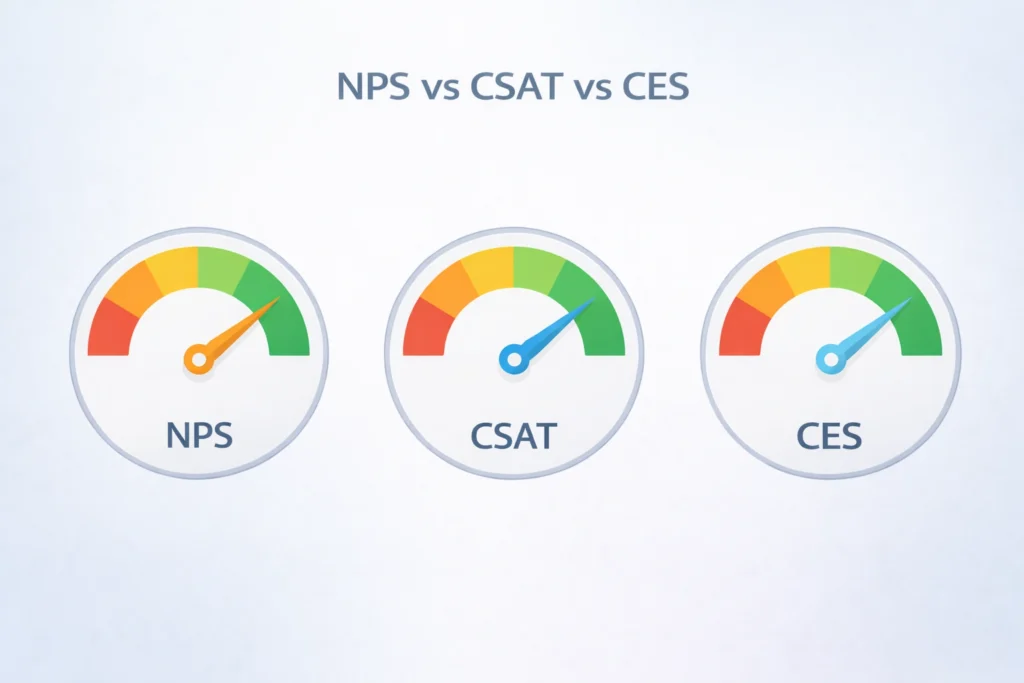
You’ve heard you should be measuring customer satisfaction. But then you Google it, and suddenly three different acronyms are staring back at you, NPS, CSAT, CES, and zero clear guidance on which one actually matters for a small business.
Here’s the short answer: they measure different things, and picking the wrong one means collecting feedback that doesn’t help you make better decisions.
This guide breaks down all three metrics in plain English, what they measure, when to use them, and which one makes the most sense depending on where your business is right now.
Why Customer Feedback Metrics Matter More Than You Think
Before we get into the acronyms, let’s anchor this in reality.
According to a 2023 PwC study, 73% of consumers say customer experience directly impacts their purchase decisions. And research from CustomerGauge shows that good customer experience can drive revenue growth by as much as 84%.
That’s not a soft, feel-good number. That’s your bottom line.
The problem is that most small businesses either don’t measure satisfaction at all — or they ask vague questions like “How are we doing?” and get vague answers that don’t tell them anything useful.
The three metrics we’re about to cover — NPS, CSAT, and CES — are built to fix that. Each one asks a specific question and gives you a specific type of insight. Once you understand what each does, you’ll know exactly which one to use (and when).
What Is NPS (Net Promoter Score)?
NPS measures customer loyalty. It asks one question:
“On a scale of 0 to 10, how likely are you to recommend us to a friend or colleague?”
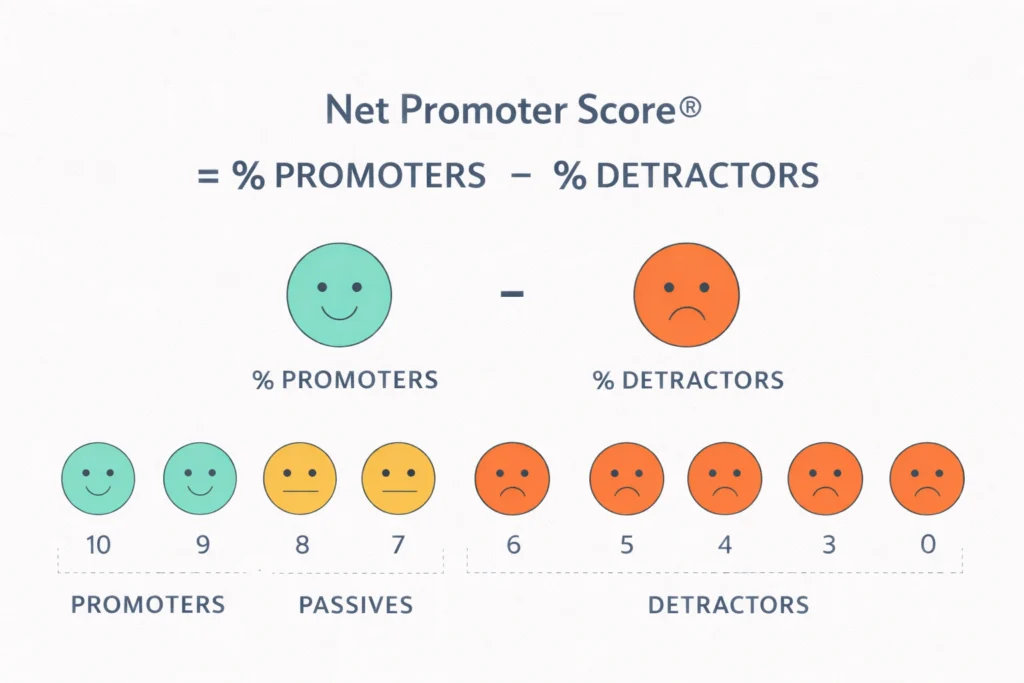
Based on the answers, customers fall into three groups:
- Promoters (9–10): Loyal fans who actively spread the word about you
- Passives (7–8): Satisfied but not enthusiastic enough to recommend you
- Detractors (0–6): Unhappy customers who may actively discourage others
Your NPS is calculated by subtracting the percentage of Detractors from the percentage of Promoters. The score runs from -100 to +100.
For SaaS companies, a score above 30 is considered good. Above 70 is exceptional.
Fred Reichheld introduced NPS in a 2003 Harvard Business Review article — and since then, research from Bain & Company has established a clear link between high NPS and revenue growth. Companies with the highest customer loyalty have been found to grow at more than double the rate of their competitors.
When Should a Small Business Use NPS?
Use NPS when you want to understand the big picture — how customers feel about your brand overall, not just one interaction. It’s ideal for:
- Quarterly health checks on your brand relationship
- Tracking whether product changes are improving or damaging loyalty over time
- Understanding how likely your customers are to refer others (a huge growth driver for small businesses with limited marketing budgets)
One important note: NPS alone doesn’t tell you why customers scored you the way they did. It’s a signal, not a full diagnosis. Always pair it with an open-ended follow-up question like “What’s the main reason for your score?” — that’s where the real insight lives.
What Is CSAT (Customer Satisfaction Score)?
CSAT measures satisfaction with a specific interaction. The question is usually something like:
“How satisfied are you with [your recent purchase / our support call / this feature]?”
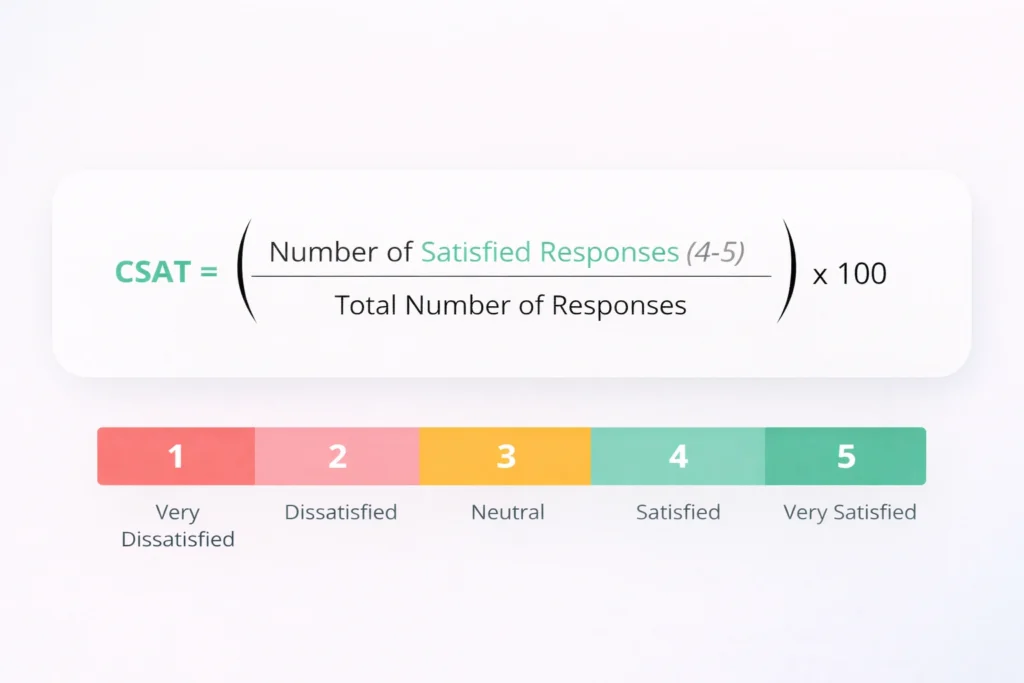
Customers respond on a scale — typically 1 to 5 or 1 to 10. Your CSAT score is the percentage of respondents who gave a positive rating (usually 4 or 5 on a 5-point scale).
The formula: CSAT = (Number of positive responses ÷ Total responses) × 100
So if 80 out of 100 customers rated their experience as 4 or 5, your CSAT is 80%.
As a benchmark, the average CSAT score for e-commerce was 80 in 2023 — so anything at or above that level is generally strong.
When Should a Small Business Use CSAT?
CSAT is your go-to metric for measuring moments — specific touchpoints in the customer journey.
It works best:
- Right after a support interaction
- Following a product purchase or delivery
- After onboarding a new customer
- When you’ve just made a change and want to know if it’s landing well
The beauty of CSAT is that it’s fast to deploy, easy to understand, and gives you immediately actionable data. If your post-support CSAT drops suddenly, you know something’s wrong with how tickets are being handled. If it’s high, you know what’s working.
The limitation? CSAT measures short-term sentiment. A customer can be happy after a single support call and still churn a month later because of a deeper dissatisfaction with your product. It captures moments — not the full relationship.
What Is CES (Customer Effort Score)?
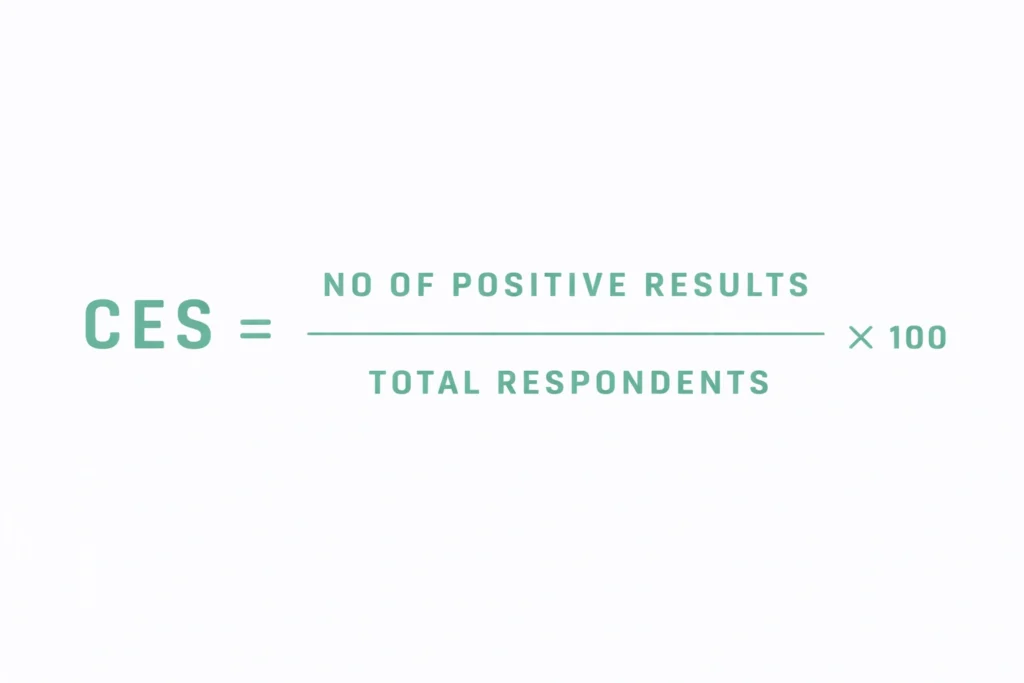
CES measures how easy it was for a customer to get something done. The question typically looks like:
“The company made it easy for me to resolve my issue.”
Customers respond on a 1–7 scale (or sometimes 1–5), from “strongly disagree” to “strongly agree.” A good CES on a 7-point scale is 5.5 or above. The cross-industry average sits around 5.99 out of 7.
CES was born from an influential Harvard Business Review article called “Stop Trying to Delight Your Customers” — which argued that reducing customer effort, not exceeding expectations, is what actually drives loyalty.
The data backs this up. Customers who experience high effort are 4x more likely to churn than those with low-effort interactions. And CES is actually 1.8x more predictive of customer loyalty than CSAT, and 2x more predictive than NPS in operational contexts.
When Should a Small Business Use CES?
CES is your friction detector. Use it whenever a customer has to do something — and you want to know if that process was easy or painful.
It’s ideal for:
- After a customer contacts your support team
- Following your onboarding or setup process
- After a checkout or payment flow
- When you’ve updated a feature and want to know if it’s easier to use
If your CES is low (high effort), you don’t just have a satisfaction problem — you have a process problem. And that’s actually easier to fix than a vague dissatisfaction.
NPS vs CSAT vs CES: A Side-by-Side Comparison
Here’s how the three metrics stack up where it matters most for small businesses:
| NPS | CSAT | CES | |
|---|---|---|---|
| What it measures | Long-term loyalty | Moment-specific satisfaction | Ease of interaction |
| The question it answers | Will they stick around and refer others? | Were they happy with that experience? | Was that easy for them? |
| Best used | Quarterly / relationship-level | After specific interactions | After task-based interactions |
| Predicts | Revenue growth, word-of-mouth | Satisfaction at touchpoints | Retention, repeat purchase |
| Limitation | Doesn’t explain why | Short-term only | Doesn’t measure overall relationship |
| Best for small biz when | Tracking brand health over time | Evaluating support & service quality | Fixing onboarding or checkout friction |
Which Metric Should Small Businesses Actually Start With?
This is the question everyone wants answered — and the honest answer is: it depends on what problem you’re trying to solve.
Here’s a practical framework:
Start with NPS if: You want to understand overall customer sentiment and whether your business is growing in the right direction. It’s the simplest single-question survey to start with, it gives you a score you can track over time, and it opens the door to qualitative follow-up that reveals what’s really going on.
Start with CSAT if: You have a customer support function and want to know if your team is handling interactions well. Or if you just launched something new and need real-time feedback on whether it’s working.
Start with CES if: Customers are complaining that things are too complicated — or if you’re losing people during onboarding, checkout, or a key workflow. CES will pinpoint exactly where the friction is.
For most small businesses just getting started with feedback, NPS is the best entry point. It’s simple, widely understood, easy to benchmark, and gives you a high-level read on your brand health that you can track quarter over quarter.
Then, as you identify specific areas that need attention, layer in CSAT and CES at the relevant touchpoints.
The Smartest Move: Use All Three Together (Without Overcomplicating It)
Here’s something the enterprise content won’t tell you: you don’t have to choose just one.
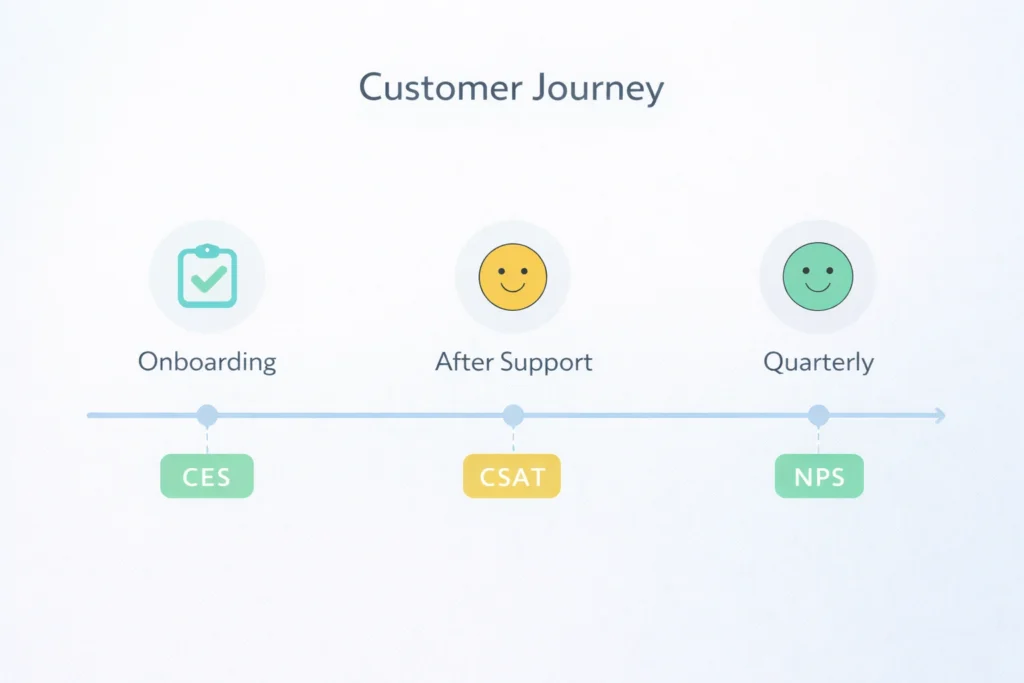
Research consistently shows that companies tracking all three metrics outperform competitors in customer retention, loyalty, and revenue growth. The key is using them at the right points in the customer journey — not sending all three surveys after every single interaction.
A practical small business setup looks like this:
- After onboarding → CES (“How easy was it to get started?”)
- After a support interaction → CSAT (“How satisfied were you with our response?”)
- Every quarter or after key milestones → NPS (“How likely are you to recommend us?”)
That gives you a complete picture without overwhelming your customers with surveys — or yourself with data you don’t know how to act on.
The Missing Piece: Collecting Metrics Is Easy. Acting on Them Is Hard.
Here’s where most small businesses get stuck.
They set up an NPS survey. They collect 50 responses. And then they open a spreadsheet, look at a number, and have no idea what to do next.
Knowing your NPS is 32 is useful. Knowing why it’s 32 — and which customer segments are bringing it down — is what actually helps you improve.
That’s why the tool you use to collect these metrics matters as much as the metrics themselves. You need something that doesn’t just aggregate scores, but surfaces the patterns and priorities in the open-ended feedback your customers leave.
This is exactly what Feedal was built for. Instead of leaving you with a spreadsheet of scores and raw comments, Feedal’s AI-powered analysis automatically reads the open-ended responses, categorizes them by theme, and highlights the issues that are coming up most often and with the most urgency. Whether you’re running an NPS, CSAT, or CES survey — or all three — Feedal helps you move from “here’s your score” to “here’s what to fix first.”
For small businesses that don’t have a full-time analyst or CX team, that’s the difference between feedback that sits in a dashboard and feedback that actually drives decisions.
Real-World Scenarios: Choosing the Right Metric
Let’s make this concrete with a few small business examples.
Scenario 1: You run an online coaching business and want to know if clients are likely to refer you. → Use NPS. Ask it after clients hit their first major milestone — that’s when loyalty is highest and referrals are most likely.
Scenario 2: You have an e-commerce store and a lot of support tickets about shipping issues. → Use CSAT after every support interaction. It’ll tell you whether your team is resolving issues to the customer’s satisfaction — and whether your shipping problem is hurting the overall experience.
Scenario 3: You’re a SaaS founder and you’re seeing a lot of drop-off during your onboarding flow. → Use CES right after new users complete setup. Low scores will tell you exactly where they’re hitting a wall.
Scenario 4: You just relaunched your product with major new features. → Use NPS two to four weeks post-launch to see if the changes are improving brand perception — and CSAT immediately after users interact with the new features for transactional feedback.
The Bottom Line
NPS, CSAT, and CES all measure different things — and none of them is universally “the best.” The right metric depends on what question you’re trying to answer.
If you only do one thing after reading this: pick one metric, build one survey, and send it to your customers this week. A 30% response rate on a five-question NPS survey will tell you more about your business than six months of guessing.
Then, once you’re collecting feedback consistently, use a tool that helps you understand what the data is actually telling you — not just what the number is.
That’s when feedback stops being a vanity metric and starts being one of your most valuable business tools.
Try Feedal for Free
If you want a form builder that helps you understand what customers are thinking — without complicated setup or confusing dashboards — Feedal.io is worth trying.
You can build your first feedback form in minutes and start collecting responses right away.
No credit card.
No pressure.
Just see if it works for your workflow.
 Prateek Pundir