
Ask any growth team what their biggest blindspot is, and most will say the same thing: they’re making decisions based on what they think their users want, not what users are actually telling them.
The feedback is out there. The surveys go out. But somewhere between the send button and the strategy meeting, the insight gets lost, buried in low response rates, surface-level answers, and analytics dashboards that show you plenty of numbers but tell you very little.
AI form builders are solving this problem in a way that no tool before them could. And if you’re a marketer, product lead, or business owner serious about staying ahead, this is the shift worth understanding right now.
Why Most Feedback Strategies Fail Before They Start
The feedback problem isn’t a motivation problem. Organizations genuinely want to hear from their customers, employees, and users. The failure happens at the form level — and it cascades from there.
Most surveys are designed by people who know too much about their own product. They ask questions that make sense internally but confuse respondents, including those with jargon.
They ask five questions in one and bury the most important on page three, by which point 60% of respondents have already dropped off.
The result is a dataset that reflects the biases of the survey designer more than the honest opinions of the people who took it. And yet, decisions get made based on that data anyway.
This is the hidden cost of bad survey design — not just wasted research time, but actively misleading analytics that steer teams in the wrong direction.

How AI Changes the Starting Point
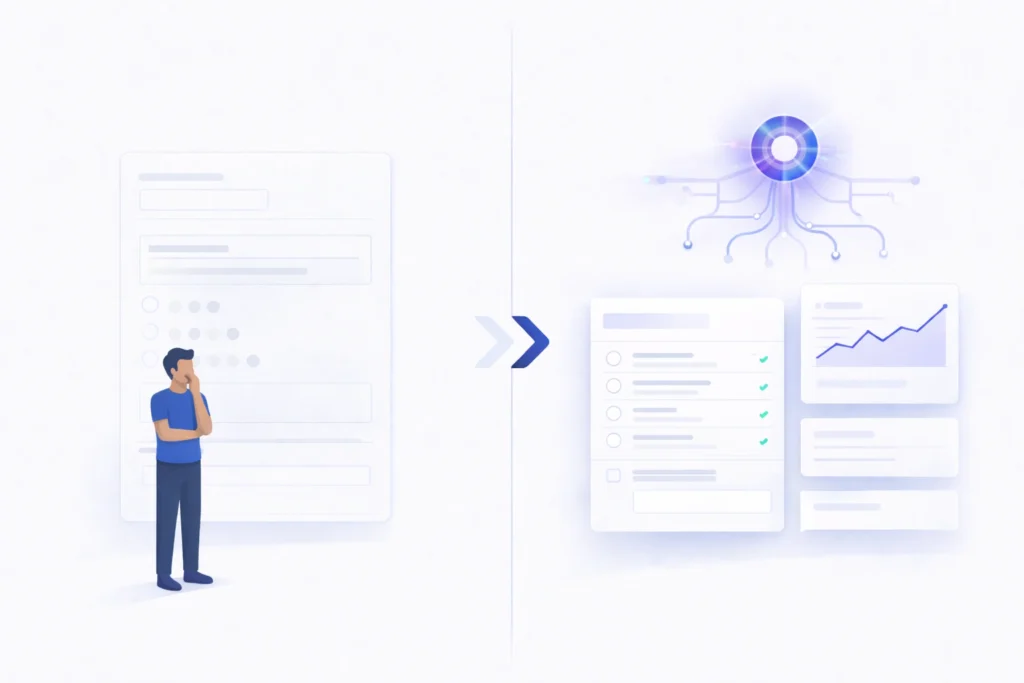
The most important thing an AI form builder does is change where survey creation begins. Instead of starting with a blank field and your own assumptions, you start with a goal, and the AI works backward from there.
You tell it what you need to understand. It generates a survey designed to surface exactly that information, using question structures, sequencing, and response formats that are optimized for clarity and completion. The questions it produces are informed by patterns across thousands of high-performing surveys, not just your best guess on a Tuesday afternoon.
This isn’t template-filling. A well-built AI form tool understands context. A feedback survey for a B2B SaaS onboarding experience should look and feel very different from a post-purchase survey for a consumer e-commerce brand, and a good AI will reflect that difference without you having to manually engineer every detail.
What you end up with is a survey that’s smarter at the source. And smarter surveys produce better feedback, which produces more reliable analytics. The improvement compounds at every step.
The Anatomy of a High-Converting AI-Generated Survey
There’s a reason AI-generated surveys tend to outperform manually designed ones on completion rate. It comes down to a few structural principles that are easy to understand but hard to consistently apply without computational help.
Length calibration: The AI knows that for most use cases, seven thoughtful questions outperform twenty generic ones. It prioritizes ruthlessly, keeping only what’s necessary to meet the research objective. This alone often doubles completion rates.
Conversational phrasing: AI form builders trained on high-quality data write questions that sound like a human conversation, not a legal deposition. Respondents are more comfortable, more engaged, and more honest when the language feels natural.
Logical branching: Rather than routing every respondent through every question regardless of their answers, AI-generated surveys adapt in real time. Someone who rates their experience a 9 out of 10 gets different follow-up questions than someone who rates it a 4. The survey becomes a conversation tailored to each individual — and the feedback you receive reflects that depth.
Response type matching: Knowing when to use a Likert scale, a multiple-choice question, an open text field, or a ranking exercise is more of a science than most people realize. AI form builders apply this judgment automatically, choosing the response format that will yield the most useful data for each specific question.
What Great Analytics Actually Look Like
Collecting better feedback only helps if you can understand it quickly. This is where many teams hit a second problem: analytics.
Most tools give you raw data and leave you to figure it out. You get a spreadsheet, a few simple charts, and a long list of written responses. Reading those comments can take a full day. By the time someone turns that data into action steps, weeks may have passed. At that point, the insight has already lost momentum. AI-powered analytics change that.
Here’s what strong feedback analysis looks like when AI handles the heavy work:
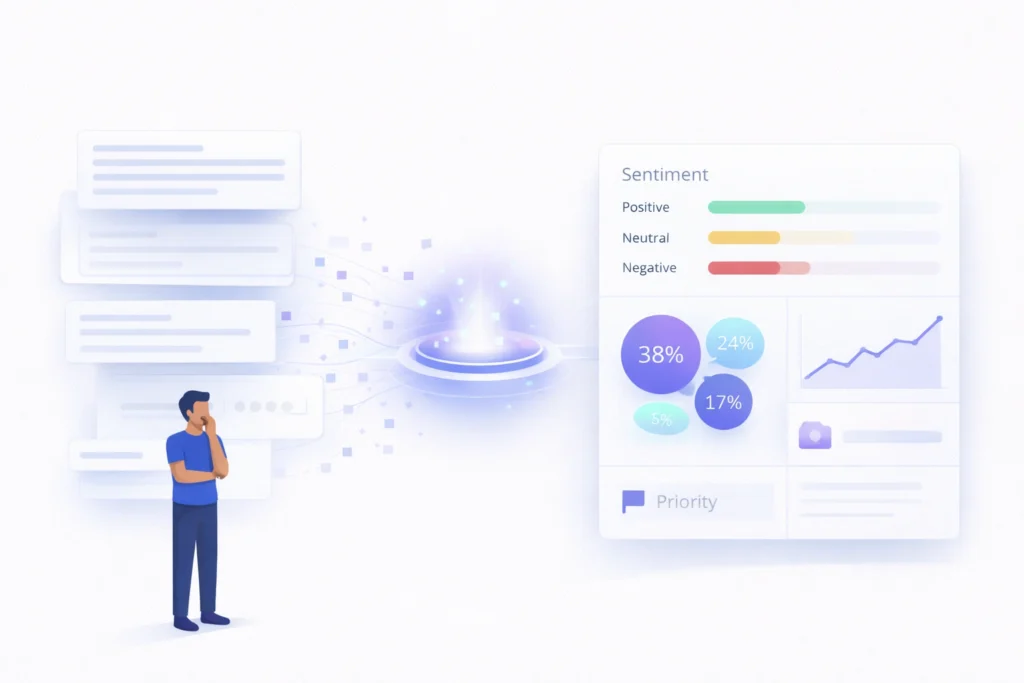
Sentiment analysis: Instead of reading every response, AI scans them for emotional tone. It sorts feedback into positive, neutral, or negative. It can also detect emotions such as frustration, confusion, and excitement. As a result, you see the overall mood in seconds.
Theme clustering: Imagine 400 people answer the question, “What is your biggest challenge with our product?” Everyone uses different words. AI groups those answers into clear themes. For example, you might learn that 38% mention onboarding issues, 24% mention pricing confusion, and 17% mention a missing feature. This takes minutes, not hours.
Trend detection: Ongoing feedback becomes powerful when you track change over time. After a product update or pricing shift, sentiment may rise or fall. AI highlights those changes automatically. Because of this, you spot problems early instead of discovering them weeks later.
Insight prioritization: Most importantly, AI doesn’t just show what is happening. It helps you see what matters most, It can connect feedback themes to user behavior, It can show which issues link to churn. It can also point out which fixes would have the biggest impact.
Building a Feedback Loop That Actually Loops
Experienced operators understand something most teams underinvest in: feedback should be continuous, not occasional. A quarterly survey gives you a snapshot of sentiment at one point in time. In contrast, a well-designed, always-on feedback system gives you a living, breathing view of what your audience is experiencing as it happens.
For years, continuous feedback sounded ideal but felt impractical. Surveys required time to design. They required effort to distribute. And they demanded even more time to analyze. Because of that operational weight, most teams limited feedback programs to a few major pushes each year.
Now, however, AI changes that equation. It reduces the manual effort at every stage. Teams can generate focused surveys in minutes. They can trigger them automatically based on specific user actions. They can also review structured insights without digging through raw spreadsheets. As a result, feedback shifts from a campaign-based activity to an ongoing system. This shift makes several powerful patterns possible.
For example, teams can send a short survey immediately after a customer support ticket closes. Since the interaction is still fresh, the responses tend to be more accurate and more detailed. Similarly, in-product surveys can trigger after a user completes a key action for the first time. That timing captures feedback in context, not weeks later when memory has faded.
HR teams can also run rotating pulse surveys. Because they target small segments at a time, they reduce fatigue while still maintaining a steady stream of insight. In addition, exit surveys can ask churned customers focused, layered questions that uncover the real reason they left — not just surface-level complaints.
Each of these workflows is manageable with AI support. Without it, each one would require significant coordination, analysis time, and ongoing oversight.
Choosing a Tool That Grows With You
The AI form builder market has grown fast. However, not every tool deserves your attention. So how should you evaluate the options in front of you?
First, assess the quality of the AI. Does the tool generate thoughtful, goal-driven surveys? Or does it simply rearrange pre-built templates? A simple test can reveal the answer. Describe a specific and nuanced research goal. Then review what the system produces. If the result looks like something you could build yourself in fifteen minutes, the AI adds little real value.
Next, examine the depth of the analytics. Basic charts are not enough. Instead, look for tools that analyze open-text responses, detect sentiment, and track trends over time. These features save hours of manual review. More importantly, they uncover insights that are easy to miss.
Then, review the integrations. Feedback only creates impact when it flows into the systems your team already uses. For that reason, prioritize tools that connect with your CRM, product analytics platform, communication channels, and project management software. Otherwise, feedback stays trapped inside the survey tool. And when that happens, it rarely shapes real decisions.
Finally, consider the respondent experience. Many buyers overlook this step. Yet it directly affects completion rates. If the survey feels slow, cluttered, or awkward, fewer people will finish it. That remains true no matter how smart the questions are. Mobile optimization, clean design, and fast load speeds are essential. Without them, even strong surveys underperform.
A Platform Worth Exploring: Feedal.io
Among the tools I’ve tested recently, Feedal.io stands out. In fact, I now recommend it to teams that want to build a serious and sustainable feedback practice.
The platform handles the entire feedback cycle in one place. First, it helps you create surveys with AI. Then, it manages distribution across channels. Finally, it analyzes responses in ways that go far beyond basic charts. Instead of simply showing answers, it interprets what people actually say. As a result, teams no longer need separate tools for survey design, data collection, and analysis. That level of consolidation alone makes it worth considering.
Feedal.io is especially valuable for SEO-focused content teams and growth marketers. Why? Because it processes open-ended feedback at scale. The system reviews responses automatically and groups them into clear themes. Therefore, you can run larger feedback programs without increasing manual work. In other words, your team spends less time organizing data and more time acting on insights. That shift makes continuous feedback not just possible, but practical.
If your current process involves building surveys by hand, exporting results into spreadsheets, and reading hundreds of responses one at a time, this tool can simplify the entire workflow. Instead of managing multiple steps across different systems, your team can work on a single unified platform. As a result, feedback becomes an ongoing advantage — not an occasional project.
The SEO Angle: Why Feedback Data Is a Content Goldmine
Here’s something many content marketers overlook: survey data is one of the richest sources of original content insight you can get. In fact, it comes directly from your audience.
For example, imagine your survey shows that 43% of customers struggle with one specific concept. That’s not just feedback. It’s a blog post idea. Similarly, if your NPS results show that the word “complicated” keeps appearing in negative responses, that signals a need for clearer messaging. And if your product data reveals that power users love a feature no one talks about, that’s a strong case study waiting to happen.
AI form builders help you spot these patterns quickly. Instead of digging through raw responses, you see clear themes and trends. As a result, these tools become more than research platforms. They turn into content intelligence engines.
Most importantly, teams that treat feedback as input for content strategy create work that truly connects. Their content reflects what people search for, struggle with, and care about. In the long run, that alignment is what drives strong organic growth.
The Compounding Return on Smarter Feedback
The teams that invest in AI-powered feedback infrastructure now are building something more valuable than a better survey tool. They’re building institutional knowledge — a continuously updated, AI-analyzed picture of what their audience thinks, needs, and experiences.
That knowledge compounds. Better surveys lead to better feedback, Better feedback leads to better analytics, Better analytics lead to better decisions, Better decisions lead to better products, better content, and better customer experiences , which generate better feedback in turn.
It’s a flywheel, and AI is what makes it spin fast enough to matter.
If your current approach to surveys, feedback, and analytics is still largely manual, the gap between you and teams using AI-powered tools is widening every quarter. The good news is that closing it has never been more accessible — the tools exist, they’re practical, and the learning curve is genuinely shallow.
The only real barrier left is deciding to start.
Working on a feedback strategy for your product or content program? The intersection of AI, surveys, and analytics is one of the highest-leverage areas in growth right now — and still underexplored by most teams.
Start Listening Smarter with Feedal
Start transforming your customer feedback today with Feedal’s AI-powered analysis.