
The 1 to 5 rating scale has become the gold standard for collecting feedback across industries. From Fortune 500 companies to small businesses, organizations rely on this simple yet powerful measurement tool to understand customer satisfaction, employee engagement, and product performance.
In this comprehensive guide, we’ll explore everything you need to know about implementing and optimizing the 1 to 5 rating scale for maximum impact.
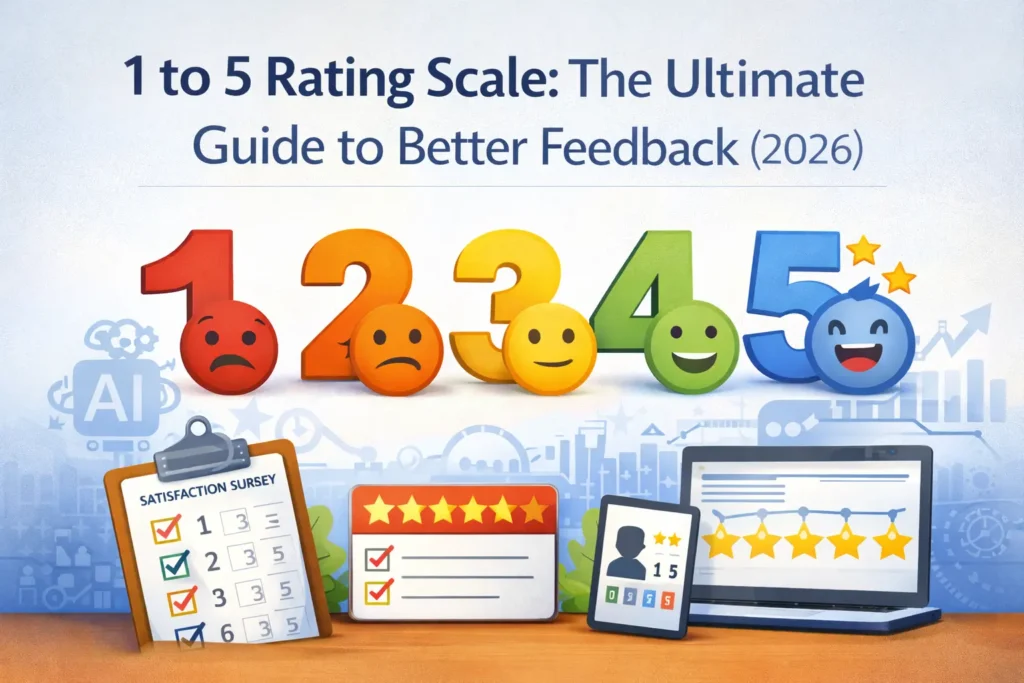
What Is a 1 to 5 Rating Scale?
A 1 to 5 rating scale is a quantitative measurement tool that asks respondents to rate something on a scale from 1 (lowest) to 5 (highest). This five-point system provides enough granularity to capture nuanced opinions while remaining simple enough for quick responses.
The beauty of the 1 to 5 rating scale lies in its versatility. Whether you’re asking “How would you rate your experience?” or “How likely are you to recommend us?”, the five-point structure adapts seamlessly to virtually any question type.
The Psychology Behind the 1 to 5 Rating Scale
Cognitive science research reveals why the 1 to 5 rating scale outperforms other options. Human working memory comfortably handles five to seven distinct categories, making a five-point scale feel natural and intuitive. When presented with more options (like a 1 to 10 scale), respondents often experience decision paralysis and response fatigue.
Additionally, the 1 to 5 rating scale mirrors how we naturally categorize experiences: terrible, poor, average, good, and excellent. This alignment with our mental models reduces cognitive load and increases response accuracy.
Types of 1 to 5 Rating Scales
Satisfaction Scale
The most common application of the 1 to 5 rating scale measures satisfaction levels:
- 1 = Very Dissatisfied
- 2 = Dissatisfied
- 3 = Neutral
- 4 = Satisfied
- 5 = Very Satisfied
Agreement Scale (Likert Scale)
Often used in research and opinion surveys:
- 1 = Strongly Disagree
- 2 = Disagree
- 3 = Neither Agree nor Disagree
- 4 = Agree
- 5 = Strongly Agree
Frequency Scale
Ideal for behavioral questions:
- 1 = Never
- 2 = Rarely
- 3 = Sometimes
- 4 = Often
- 5 = Always
Quality Scale
Perfect for product or service evaluation:
- 1 = Very Poor
- 2 = Poor
- 3 = Fair
- 4 = Good
- 5 = Excellent
When to Use a 1 to 5 Rating Scale
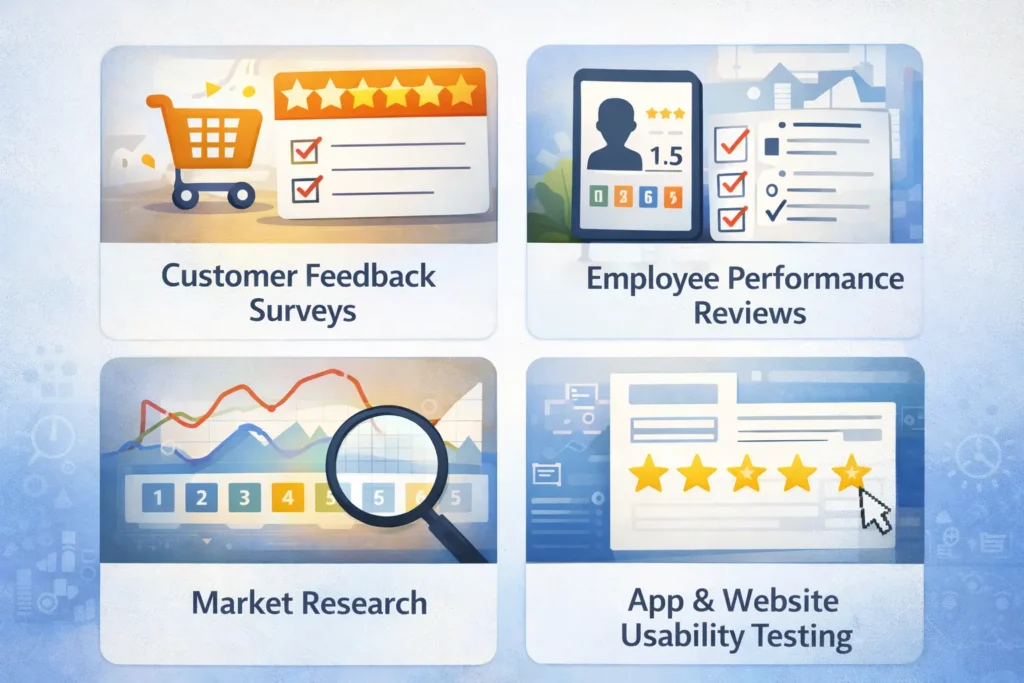
Customer Feedback Surveys
Post-purchase surveys, customer service evaluations, and product reviews all benefit from the 1 to 5 rating scale. The quick response format increases completion rates while providing quantifiable data you can track over time.
Employee Performance Reviews
HR teams use the 1 to 5 rating scale to standardize performance evaluations across departments. This consistency enables fair comparisons and helps identify high performers and areas needing development.
Market Research
Understanding consumer preferences, brand perception, and purchase intent becomes measurable with a 1 to 5 rating scale. Researchers can segment responses by demographics and identify statistically significant patterns.
Website and App Usability Testing
UX designers rely on the 1 to 5 rating scale to evaluate interface intuitiveness, feature usefulness, and overall user satisfaction. These metrics directly inform design iterations and prioritization decisions.
How to Design Effective 1 to 5 Rating Scale Questions
Start with a Clear Objective
Before creating your survey, define what you want to measure. A vague objective leads to vague questions and unusable data. Are you measuring overall satisfaction, specific feature performance, or likelihood to recommend?
Use Specific, Action-Oriented Language
Instead of “How do you feel about our product?”, ask “How satisfied are you with our product’s ease of use?” Specificity on a 1 to 5 rating scale produces actionable insights.
Maintain Consistency
Use the same 1 to 5 rating scale format throughout your survey. Switching between different anchor points (satisfaction, agreement, frequency) within a single survey confuses respondents and corrupts your data.
Avoid Leading Questions
Neutral wording is critical. “How would you rate our exceptional customer service?” introduces bias. Instead, ask “How would you rate the customer service you received?”
Include an Odd Number of Options
The middle option (3) in a 1 to 5 rating scale allows respondents to express genuine neutrality. While some practitioners prefer even-numbered scales to force a positive or negative lean, most contexts benefit from acknowledging that not every experience is clearly positive or negative.
Analyzing 1 to 5 Rating Scale Data
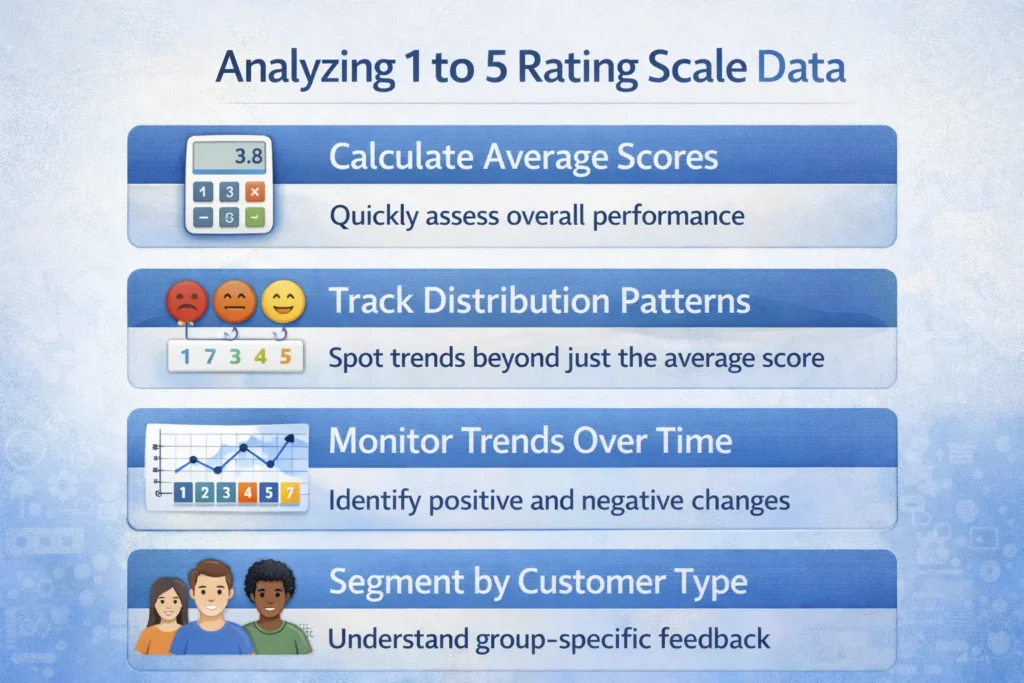
Calculate Average Scores
The mean score from your 1 to 5 rating scale provides a quick snapshot. A score above 4.0 generally indicates strong performance, while anything below 3.0 signals serious issues requiring immediate attention.
Track Distribution Patterns
Don’t just look at averages. Examine how responses distribute across your 1 to 5 rating scale. Are most responses clustered at 5, or do you see a bimodal distribution with peaks at both ends? Distribution patterns reveal insights averages mask.
Monitor Trends Over Time
Single measurements provide limited value. The real power of the 1 to 5 rating scale emerges when tracking scores across weeks, months, or years. Trending upward? Your improvements are working. Declining scores? Time to investigate.
Segment by Customer Type
Break down your 1 to 5 rating scale results by customer segment, product line, or geographic region. You might discover that one product consistently underperforms while another delights customers.
Identify Detractors and Promoters
Respondents giving 1-2 on your 1 to 5 rating scale are detractors who need immediate attention. Those rating 4-5 are promoters—potential advocates who might provide testimonials or referrals.
Common Mistakes with 1 to 5 Rating Scales
Too Many Questions
Survey fatigue kills completion rates. Limit your 1 to 5 rating scale surveys to 5-10 questions maximum. Prioritize quality over quantity.
Poorly Labeled Scales
A 1 to 5 rating scale without clear labels creates confusion. Always define what each number means. Never assume respondents intuitively understand your scale.
Ignoring Cultural Differences
Response patterns vary across cultures. Some cultures tend toward extreme responses while others cluster around middle values. Consider these tendencies when analyzing global data.
Not Acting on Results
Collecting 1 to 5 rating scale feedback without taking action wastes everyone’s time and damages trust. Always close the feedback loop by communicating what you’ve learned and what you’re changing.
Advanced Tips for Maximizing Response Quality
Randomize Answer Order
When using multiple 1 to 5 rating scale questions, randomize their order to prevent response patterns and bias.
Use Progressive Disclosure
For longer surveys, show one question at a time rather than overwhelming respondents with a full page of 1 to 5 rating scales.
Add Optional Comment Fields
Pair your 1 to 5 rating scale questions with optional text boxes. Quantitative ratings tell you “what” but comments explain “why.”
Time Your Surveys Strategically
Send your 1 to 5 rating scale surveys when experiences are fresh—within 24 hours of purchase, service interaction, or event completion.
Mobile Optimization Is Essential
Over 60% of surveys are now completed on mobile devices. Ensure your 1 to 5 rating scale displays properly and functions smoothly on smaller screens.
Technology Solutions for 1 to 5 Rating Scales
Managing feedback at scale requires robust technology. Modern feedback platforms streamline the entire process from survey design through analysis and reporting.
Platforms like Feedal.io specialize in making 1 to 5 rating scale surveys effortless. With drag-and-drop survey builders, automated distribution across email and SMS, real-time analytics dashboards, and integration with your existing CRM and business tools, you can focus on insights rather than survey mechanics.
The right platform transforms raw 1 to 5 rating scale responses into strategic business intelligence, automatically flagging negative feedback for immediate follow-up, tracking trends across customer segments, and generating executive-ready reports that drive decision-making.
Real-World Success Metrics
Organizations that effectively implement 1 to 5 rating scale feedback systems typically see:
- 25-40% higher survey completion rates compared to longer, open-ended surveys
- Faster issue identification with real-time alerts when ratings drop below thresholds
- Improved customer retention by proactively addressing dissatisfaction
- Data-driven decision making replacing gut feelings and assumptions
- Quantifiable ROI from tracking satisfaction improvements against business outcomes
The Future of Rating Scales
Artificial intelligence is enhancing the traditional 1 to 5 rating scale by predicting future ratings based on behavioral data, automatically categorizing open-ended comments, and identifying sentiment patterns humans might miss. However, the fundamental simplicity and effectiveness of the five-point system ensures its continued relevance.
Smart organizations are now combining 1 to 5 rating scales with other metrics like Net Promoter Score and Customer Effort Score to build comprehensive feedback ecosystems that capture the full customer experience.
Taking Action: Your Next Steps
If you’re ready to harness the power of the 1 to 5 rating scale:
- Define your objectives – What specific insights do you need?
- Design targeted questions – Keep it simple and focused
- Choose the right platform – Invest in tools that scale with your needs
- Start small – Test with a limited audience before rolling out broadly
- Act on feedback – Use insights to drive continuous improvement
The 1 to 5 rating scale remains one of the most effective feedback tools available. Its simplicity masks powerful capabilities for understanding customers, employees, and stakeholders. By following best practices and leveraging modern technology, you can transform simple numerical ratings into strategic advantages that differentiate your business.
Ready to implement professional 1 to 5 rating scale surveys that drive real results? Modern feedback platforms make it easier than ever to collect, analyze, and act on customer insights at scale.
 Prashant Sharma